

[av_one_full first min_height=” vertical_alignment=” space=” custom_margin=” margin=’0px’ row_boxshadow=” row_boxshadow_color=” row_boxshadow_width=’10’ link=” linktarget=” link_hover=” title_attr=” alt_attr=” padding=’0px’ highlight=” highlight_size=” border=” border_color=” radius=’0px’ column_boxshadow=” column_boxshadow_color=” column_boxshadow_width=’10’ background=’bg_color’ background_color=” background_gradient_color1=” background_gradient_color2=” background_gradient_direction=’vertical’ src=” background_position=’top left’ background_repeat=’no-repeat’ animation=” mobile_breaking=” mobile_display=” av_uid=’av-1qz7v’]
[av_heading heading=’El gran reto de retener al cliente’ tag=’h2′ link_apply=” link=’manually,http://’ link_target=” style=’blockquote modern-quote’ size=” subheading_active=” subheading_size=’15’ margin=” margin_sync=’true’ padding=’10’ color=” custom_font=” av-medium-font-size-title=” av-small-font-size-title=” av-mini-font-size-title=” av-medium-font-size=” av-small-font-size=” av-mini-font-size=” av_uid=’av-k0o2y3lo’ custom_class=” admin_preview_bg=”][/av_heading]
[/av_one_full]
[av_one_full first min_height=” vertical_alignment=” space=” custom_margin=” margin=’0px’ row_boxshadow=” row_boxshadow_color=” row_boxshadow_width=’10’ link=” linktarget=” link_hover=” title_attr=” alt_attr=” padding=’0px’ highlight=” highlight_size=” border=” border_color=” radius=’0px’ column_boxshadow=” column_boxshadow_color=” column_boxshadow_width=’10’ background=’bg_color’ background_color=” background_gradient_color1=” background_gradient_color2=” background_gradient_direction=’vertical’ src=” background_position=’top left’ background_repeat=’no-repeat’ animation=” mobile_breaking=” mobile_display=” av_uid=’av-1qz7v’]
[av_textblock size=” font_color=” color=” av-medium-font-size=” av-small-font-size=” av-mini-font-size=” av_uid=’av-72yhf’ custom_class=” admin_preview_bg=”]
If We Group the Digital Strategies I always suggest separating digital strategies into two main groups: those that generate proactive communication about a product or concept, called "outbound," and those that aim to attract customers who have a pre-existing need, called "inbound." That's why not all digital strategies should use social media or Google Ads as tactics.
The General Concept of Inbound Marketing This stems from a premise based on a prior need, which triggers a search on engines like Google or Bing, or results from a previous interaction with a website, landing page, or blog.
In theory, every business should map or identify its digital customer journey to understand which and how many previous interactions occur before a purchase decision. Thinking that on their first visit to a travel website a customer will buy a plane ticket is perhaps simplistic, given that our behavior as consumers motivates us to compare, procrastinate, and postpone decisions.
Based on the above, inbound tactics can find ways to invite a consumer to return to the desired site to make a purchase, through retargeting technologies that can reinforce messages or emails based on the audience's previous actions.
One of the most common retargeting tactics occurs when a customer enters an e-commerce website, reaches the shopping cart, and for some reason abandons the purchase. This can happen for reasons unrelated to the initial decision, so efforts to recover the sale have proven very profitable in other countries.
In a recent column, David Chaffey shares a study showing the transaction abandonment rate by industry, with the average being quite alarming at 75.4%.
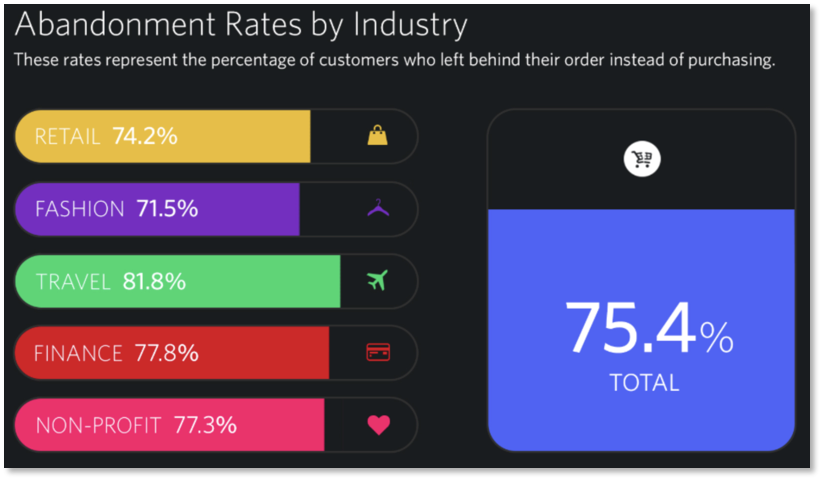
This means that usability and digital advertising efforts can be diminished at the crucial moment of the transaction. However, regardless of technical and usability analysis, there are reasons attributable to the consumer, who deserves a second chance to reconsider their decision and return to the checkout. For this, retargeting efforts work very well to try to salvage the sale, which is usually done through advertising and retargeting or an automatically triggered email.
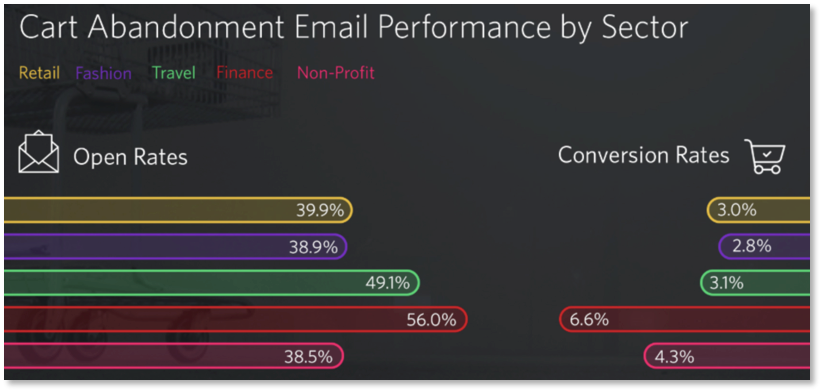
Timely execution of emails to rescue transactions has proven to be an excellent and cost-effective mechanism, as illustrated in the following graph. It is most effective in the financial sector, with a 6.6% conversion rate for a rescue email. In the retail sector, it is around 3%, which is still quite significant.
The truth is that the digital medium now allows for quick and non-intrusive customer follow-up. In the offline world, it's more difficult to track a customer who abandons their purchase in a supermarket, but in the digital realm, there are more possibilities, provided we have a clear justification, an attractive incentive, and the right moment to do so.
Source: merca20.com/the-great-challenge-of-retaining-customers
[/av_textblock]
[/av_one_full]