


[av_two_fifth first min_height='' vertical_alignment='' space='' custom_margin='' margin='0px' row_boxshadow='' row_boxshadow_color='' row_boxshadow_width='10' link='' linktarget='' link_hover='' title_attr='' alt_attr='' padding='0px' highlight='' highlight_size='' border='' border_color='' radius='0px' column_boxshadow='' column_boxshadow_color='' column_boxshadow_width='10' background='bg_color' background_color='' background_gradient_color1='' background_gradient_color2='' background_gradient_direction='vertical' src='' background_position='top left' background_repeat='no-repeat' animation='' mobile_breaking='' mobile_display='' av_uid='av-n0ht8']
[av_image src='https://abrahamgeifman.com/wp-content/uploads/2019/07/abraham-geifman.jpg' attachment='234' attachment_size='full' align='center' styling='' hover='' link='' target='' caption='' font_size='' appearance='' overlay_opacity='0.4' overlay_color='#000000' overlay_text_color='#ffffff' copyright='' animation='no-animation' av_uid='av-jy9a7qye' custom_class='' admin_preview_bg=''][/av_image]
[/av_two_fifth]
[av_three_fifth min_height='' vertical_alignment='' space='' custom_margin='' margin='0px' row_boxshadow='' row_boxshadow_color='' row_boxshadow_width='10' link='' linktarget='' link_hover='' title_attr='' alt_attr='' padding='0px' highlight='' highlight_size='' border='' border_color='' radius='0px' column_boxshadow='' column_boxshadow_color='' column_boxshadow_width='10' background='bg_color' background_color='' background_gradient_color1='' background_gradient_color2='' background_gradient_direction='vertical' src='' background_position='top left' background_repeat='no-repeat' animation='' mobile_breaking='' mobile_display='' av_uid='av-e0m38']
[av_textblock size='' font_color='' color='' av-medium-font-size='' av-small-font-size='' av-mini-font-size='' av_uid='av-jy9a82kc' custom_class='' admin_preview_bg='']
I have discussed in this space the importance of identifying the digital customer journey…
… which reveals the customer’s emotional state and the number of digital and physical touchpoints or interactions required before a customer or consumer purchases and uses our product or service.
[/av_textblock]
[/av_three_fifth]
[av_one_full first min_height=” vertical_alignment=” space=” custom_margin=” margin=’0px’ row_boxshadow=” row_boxshadow_color=” row_boxshadow_width=’10’ link=” linktarget=” link_hover=” title_attr=” alt_attr=” padding=’0px’ highlight=” highlight_size=” border=” border_color=” radius=’0px’ column_boxshadow=” column_boxshadow_color=” column_boxshadow_width=’10’ background=’bg_color’ background_color=” background_gradient_color1=” background_gradient_color2=” background_gradient_direction=’vertical’ src=” background_position=’top left’ background_repeat=’no-repeat’ animation=” mobile_breaking=” mobile_display=” av_uid=’av-apbc4′]
[av_textblock size=” font_color=” color=” av-medium-font-size=” av-small-font-size=” av-mini-font-size=” av_uid=’av-jy9a8xaj’ custom_class=” admin_preview_bg=”]
An important part of this journey is understanding the internal stages customers experience—both mentally and emotionally—in relation to their needs or concerns. It means returning to the fundamentals of marketing and identifying wants and needs, but viewing them from a digital perspective.
To accomplish this, we must identify and document this flow of interest or need through what the website The Coloring defines as the Empathy Map and its four components, illustrated below:
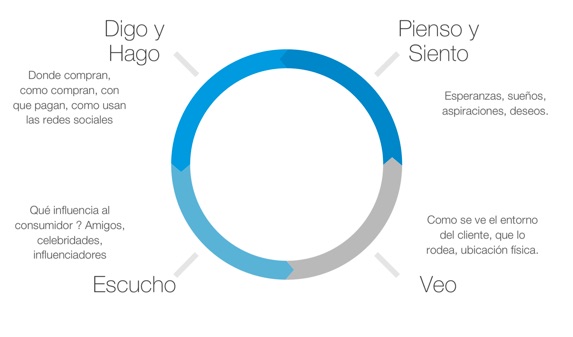
These four stages are directly connected to a process in which customers gradually become aware of their needs, expressed through distinct behaviors in digital media. This directly affects the types of searches we perform on Google.
This process works as illustrated in the following table:
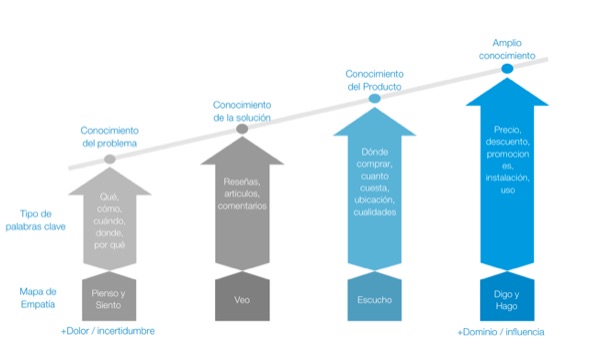
Problem Awareness: At this point, consumers recognize a problem, business pain point, or opportunity but do not know how to address it. In the B2B world, for example, they may realize that they need a system to track sales activities, reports, and opportunities. Their searches at this stage are informational, broad, and driven by numerous unanswered questions.
Solution Awareness: At this point, the customer already understands the problem and begins searching for a solution. In the same example, the customer knows that a CRM system can solve the problem but lacks information about brands, prices, or how to obtain one. The content should therefore be more informative and provide greater detail and depth regarding advantages, disadvantages, and other relevant information.
Product Awareness: At this stage, customers have already identified the brand or brands that may work for them. The next step is to help them complete the cycle by providing information about pricing, terms, features, and product details. Following the same example, this is where customers may compare brands based on both functionality and price.
Full Awareness: At this point, the customer is already “empowered” with all the information needed to purchase, use, and recommend the product.
As we can see, the empathy map and an understanding of the customer-awareness cycle are essential both to digital strategy and to executing tactics such as SEM, SEO, and display advertising more effectively.
[/av_textblock]
[/av_one_full]